Garage drywall and HVAC
Winter didn’t end with the beginning of March. Nothing unusual about this. With the insulation, the house was warm nonetheless, especially on sunny days. The garage was something else, and we had to bring the second heater into it, so that we could hang the drywall. The latter was an important step in that, once done, it’s then possible to move belongings from the unheated storage unit to the garage. Finally, we can start bringing in belongings and feel a bit like it’s home.
The heater in the basement does a good job of providing warmth to the entire house, but it really is time to try out the heating system. Mercifully, Neil Chenier was prepared to bring the crew in at the same time as the septuagenarian Dicaire brothers came to do the drywall. All in all, a very busy time.
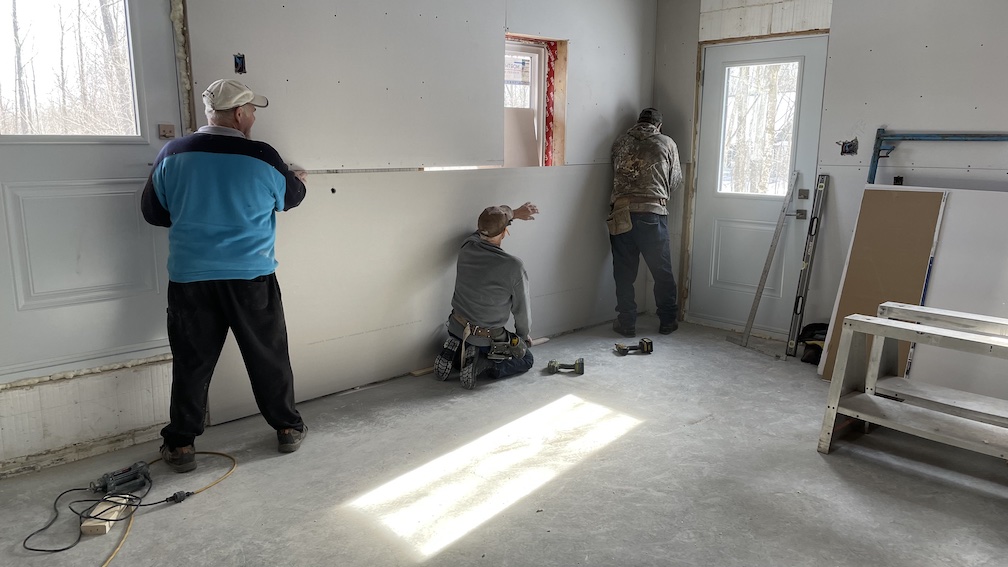
Michel and Denis Dicaire are two short and wiry individuals with a long work background. They still zip along climbing scaffolding lifting sheets and screwing them in. Even though the garage has a 12 ft ceiling, with the help of Dennis’s drywall lift, it was covered in a short day. Shifting the scaffolding around was the clumsy part, as we had to negotiate the garage door openers and rails. Dennis watched all this with care and we avoided any mishaps. In two days and change, the garage was complete and ready to receive the stuff in storage. The best part: the brothers are up for doing the walls in the basement once the HVAC has been installed and inspected.


While the drywall was going up in the garage, Neil and John, the tinsmith, began work on the HVAC. First, the ducts went up: main trunks for heat and cold return, as well as the separate lines spread throughout the house. Given the house design, the duct layout is fairly straightforward. Nonetheless, the work took about 4 days with the last tasks, connecting the hot plenum and cold return to the air handler and boring holes through the concrete for the HRV, happening after work on the heating equipment started.
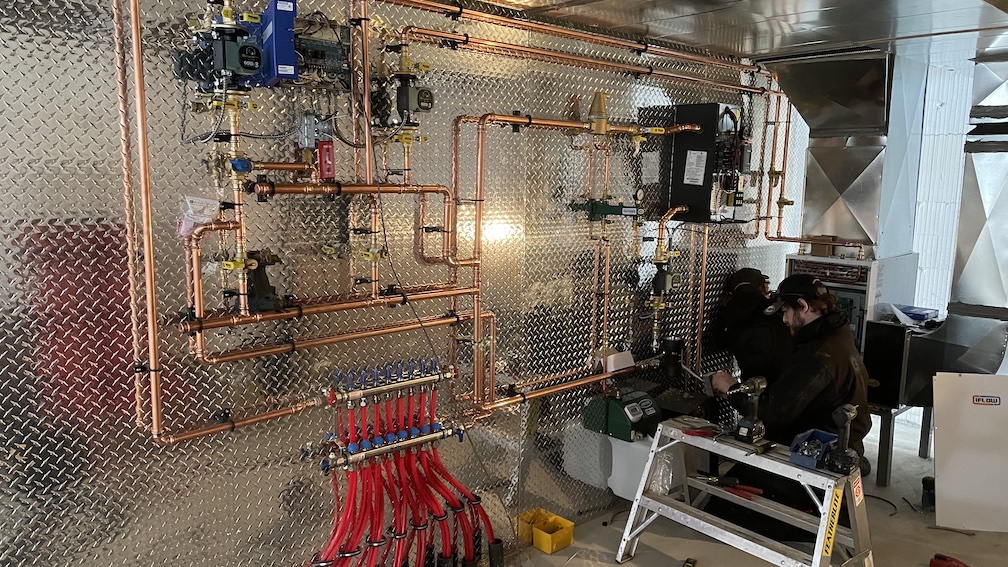
The heating equipment layout is a work of art. Even Dennis marvelled at the quality of the work. Kirk and Eric, the electricians, had the same reaction when they came to do the hookup to the panel. Neil is an interesting guy, totally absorbed by his craft and clearly a perfectionist. He and John collegially approve of each other’s work only if is done in the most efficient and aesthetic fashion. It definitely strikes you that way when you see it.
The setup includes the electric boiler that is attached on the right side to an air handler-furnace incorporating a hot water coil to heat the forced air to both the main floor and basement. This is to be used in the shoulder seasons and to top off the heat generated by the infloor heating attached to the boiler on the left side. The array of pipes, pumps, expansion tank and manifold are assembled on a glistening sheet of steel. There is room left for a buffer tank should we make the move to a heat pump that can do the radiant heat.
Doing cooling with the heat pump may be a challenge because current technology would have the cooling done infloor and not forced air — not particularly efficient. This is where this house is serving as a bit of R and D for Neil. This is Neil’s first electric boiler install. It’s about one third the size of a propane boiler, and twice the heating capacity of what the HVAC plans called for. This is to correct for the lower R-value in the actual house walls. The idea is to run a season with the boiler, see how well it heats and how much it costs. If it is efficient in both senses, the expense of a heat pump may not be warranted, and we might just add a cheaper conventional air con unit. Also, in the meantime, these air to water systems are new and developments are happening all the time. Neil is staying up to date with the tech by following seminars and industry news. I will certainly be checking the latter. Possibly, in a year or two, some other answer might present itself. He wants to keep chatting about things and use our experience as a staging ground for his future practice. I told him we could put a Chenier Mechanical flag out front. He’s up for it.




As I write this, Neil and he crew are scheduled to come tomorrow to load distilled water into the pipes, check the pressure, turn on the boiler and the entire infloor system. I am very hopeful, as I would like to have some sense of its functioning while there is still some cool, if not cold weather.
Lots has been going on in the last few weeks, delaying my posting. We are in the midst of things: more drywall for the basement delivered and sitting in the garage. Installation has had to wait for the HVAC inspection. Mercifully, though predictably, given the quality of Neil’s and John’s work, this passed. Along with this inspection, the framing and insulation inspections were fully carried out and passed as well. Unbelievably, we are left with only the occupancy inspection which includes steps, handrails, and any other possible, and likely, minor code violations.
Next week the Dicaire brothers and Richard are scheduled to do the drywall in the basement, and for John, Dennis’s brother, to do the joints. I got in touch with yet other clan members, this time Robbie’s sister and brother-in-law, Dennis’s niece and her husband, to do the primer and ceiling painting. This should be done by mid to late April. Fingers crossed.
It has also been time to start moving stuff out of storage to the house. We have had 2 storage units, one inside heated, the other outside with mostly with garden implements, my tools and lumber. We ended the lease at the end of March for the latter unit, and end of April for the inside one holding much of the furniture and household stuff. In the couple of weeks, we have moving smaller loads to the garage. Prior to this, we had to deal with a transportation contingency.
At the end of February, my car gave up the ghost. At 205,000 km, it was needed endless repairs. I had to find something else, and this became an all consuming project for a couple of weeks. We stumbled on something, and so far, it looks like we got lucky enough. Never bought a used vehicle before. Yet, it appears like we managed to evade some of the worst used car salesman clichés. So far this vehicle proved to be very useful for the move. We’ll see what, if any, surprises are inflicted upon us in the next while.

