Design
Simplicity, function, comfort. A building to age in place and not break the bank. A few architectural perks, without too many compromises. Project goals appear achievable, but practicalities — money, code, convention, craft and real world conditions — readily present challenges. Negotiations and workarounds are possible but flatten out aspirations. Nothing new, but here’s how it played out for this house.
The aspirational
We had some ideas in mind stemming from houses we’d seen. Lena came across the work of Bryan Mckay-Lyons, a Nova Scotia architect, who usually works at a high level, but also does the odd modest structure. For instance, the Muir-Craig house at 1400 sq. ft. has the size of footprint we were looking for.

The Roy house is a larger home of a similar style.

We like the minimalist lines with corrugated steel sheathing, asymmetrical openings, floor to ceiling windows and open concept interior. The shell well complements a large country lot. Omar Gandhi is another architect who has a great range, but also designs some residences in a similar style. His Black Gables house is a fine example, but we are still talking high end.
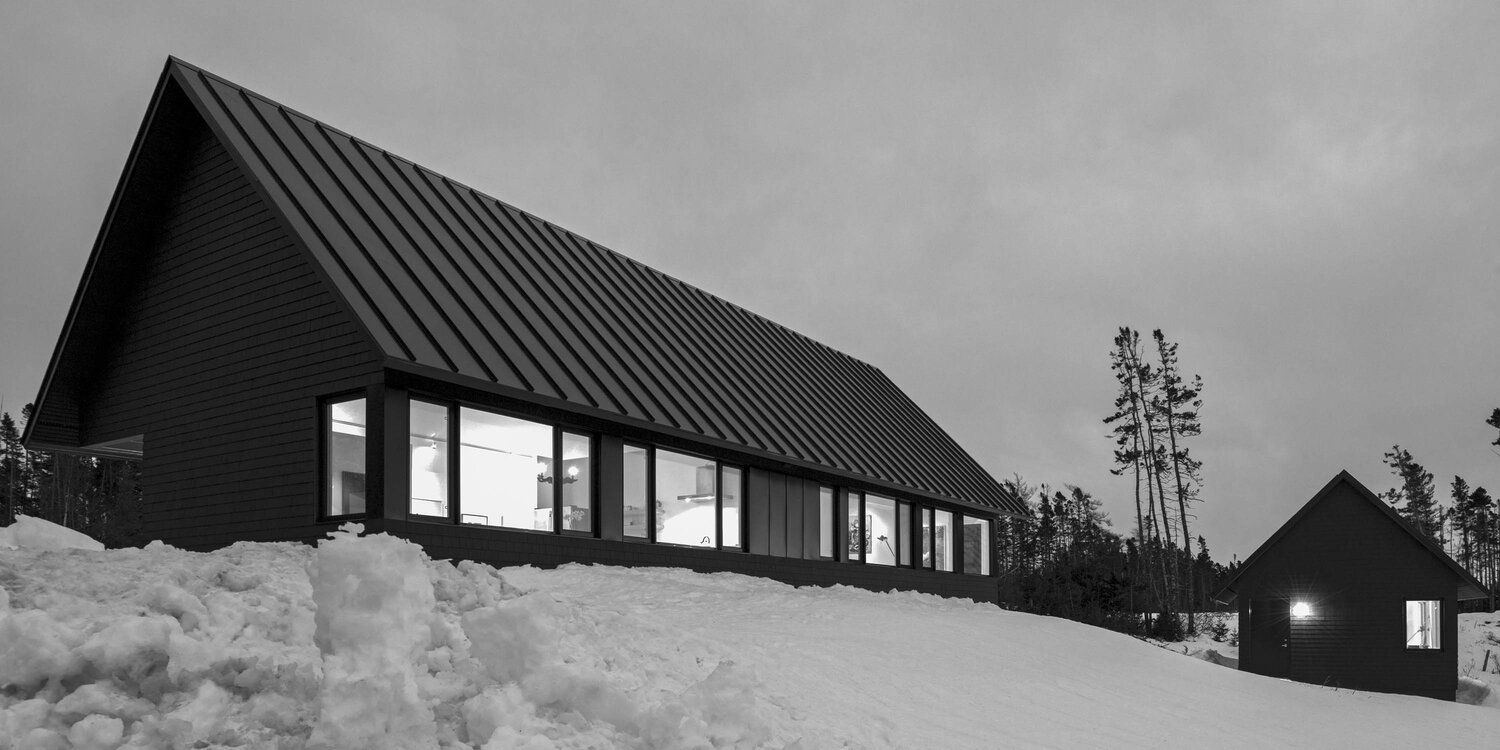
Yet, these buildings are clearly holiday homes, not necessarily fit to be a permanent home for old folks, located in a more moderate climate than Eastern Ontario. We can’t afford such an architect, and getting someone in our locality to build this way was an open question. We thought we’d simplify and lower aspirations.
Getting real
Internet research coughed up some more plausibly affordable ideas with models whose plans you can purchase on line. This plan struck us a reasonable down market compromise — minus the stack.
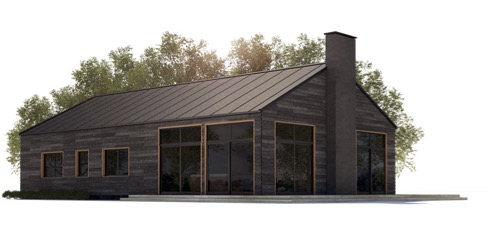

Simple, keeping some of the desired features, but easy enough to use readily available and less costly materials for exterior, such as a basic steel roof and vinyl siding. It turned out though that for any builder in Glengarry, a house with no overhanging eaves was a non-starter. Precipitation would quickly affect the structure. This model then morphed to this next one.

A more conventional look, again making it possible to use more conventional materials. The other major departure from the original inspiration is the flatter roof, 6/12 instead of the saltbox 10/12 or 12/12. Of course, this is the conventional bungalow look, by no means as dramatic as the steeper pitched models. On the other hand, simpler and cheaper to build. Other things take precedence given our limited budget, making it possible to still include a few special features.
Planning the actual house in the actual place.

First thing is that we are talking slope. The land slopes south at a fair pitch, similar in feel as the photo, making it possible to have a walkout basement. Bungalow, but 2 stories on one side, the south side where we can take advantage of the light, especially in the winter.
In Ontario, you need to have drawings done by a certified architectural technician. Prior to getting in touch with one, we wanted to have a sketch drawn up to provide the essential’s of what we wanted. I tried using Sketchup, but found it too cumbersome, especially on a small screen and a touchpad. I then discovered Flooplanner and found it much easier to use. You can do the floor layout in 2D, and then generate a 3D image from both outside or any point inside. The downsides are that, in the free version, you can only generate one floor per drawing, and you can’t add a roof. Nonetheless, you can do many essentials to give some sense of the project.
The interior
This is a small house — 1350 sq. ft interior space per floor. A number of features are aimed at assembling a space convenient for aging in place.
- The house walls are make of insulated concrete forms [ICF] chosen, along with triple glazed windows and R-60 insulation in the roof, for higher, consistent insulating value.
- The main source of heating is to be an electric boiler generated infloor, hydronic radiant system installed in the basement’s concrete floor. Radiant heating is considered to provide the most comfortable warmth. This along with the south facing walkout should make the basement as comfortable as the main floor. We are looking into a heat pump for air conditioning and a backup heat source.
- The house is just slightly past the minimum setback from the road along a straight flat driveway. Entrance to the house interior can be done from the garage, avoiding walking on ice in winter.
- All the living can take place on one floor. Yet, the straight staircase to the basement could accommodate a chair lift if necessary.
- Open space design makes mobility, even wheel chair mobility easier. The exterior doors are all 36 inches, and the interior doors will be oversize as well.
- Shower in the master bedroom ensuite will be a walk in with no door.
- Lower cupboards and pantries are either drawers or pullouts.
Floorplanner‘s strength is in the interior design. It certainly can communicate room placement and dimensions. It can also give you some limited sense of what the various spaces will look like.

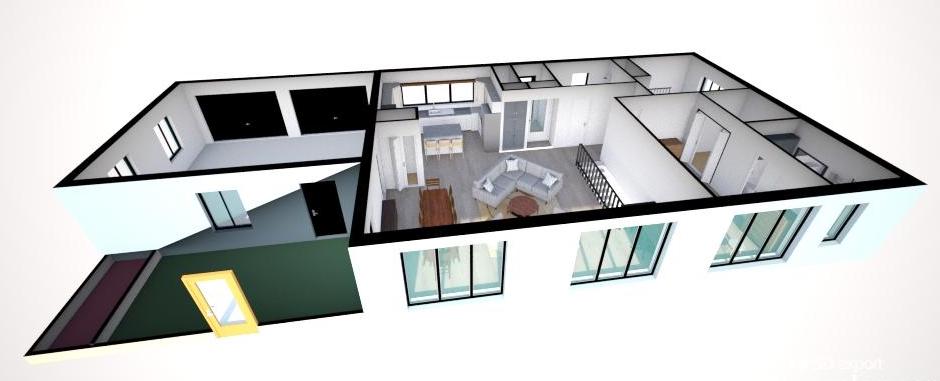

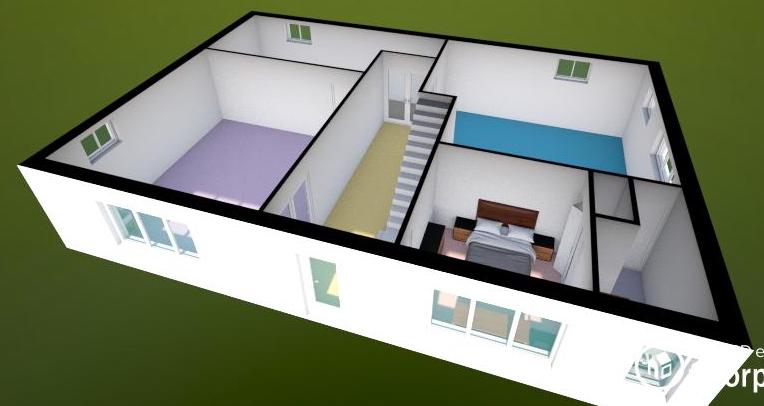

The models above were drawn up and then edited after a few exchanges with the designer. The layout is much the same. Some diminished window sizes are the most significant change. It appears that for ICF code requires that windows be 20 in above floor and one foot below ceiling. An instance of literal flattening of the original vision. One small basement window disappears on the [south] west corner and the closet at the entrance from the garage is eliminated.


The exterior
Conventional practices present constraints that can still surprise. Lino, the designer, is an affable and helpful fellow, and this made me forget that he works in the generic styles common with developers in the area. His first designs further diminished our aspirations. Knocked off the architectural pedestal, and dropped into an average subdivision.


The fenestration was the other major problem. Dull, predictable dimensions and placement. We were less concerned with the curb appeal and more interested in the interior experience of the outside. Hence, wider than conventional kitchen windows and a corner window in the second bedroom. Lino received our feedback straightaway and he was generous about making alterations. A few exchanges and he arrived at the final version.

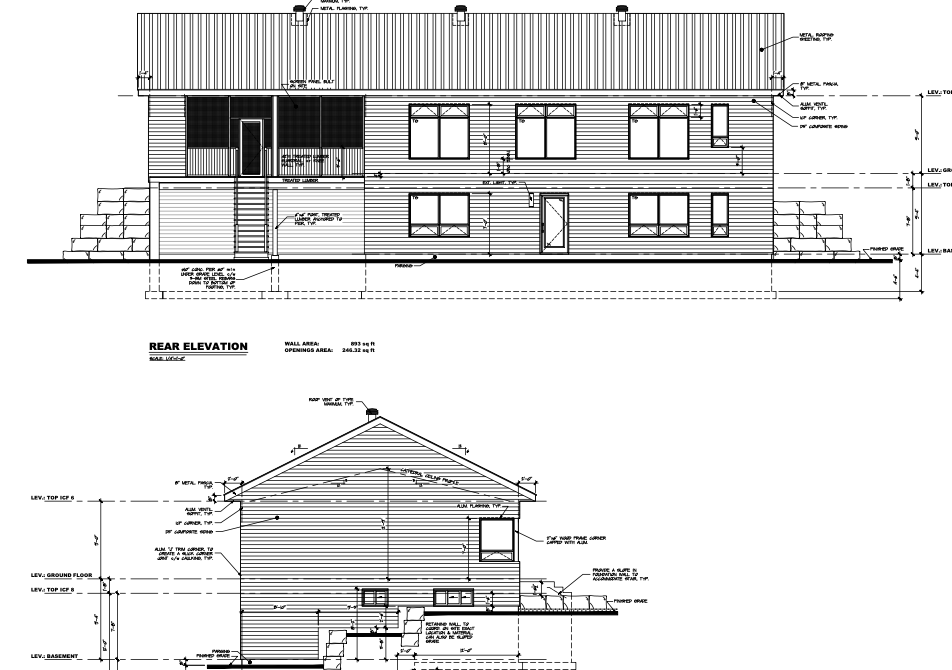
It’s looks like an ordinary bungalow with a few modest variations [larger windows on the south side, walk out basement, 8 foot walls in the basement, 9 foot walls on main floor with a slightly vaulted, 12 foot ceiling], but it doesn’t create too many construction complexities, nor extra, purely aesthetic based expenses. We hope the setting will complement and elevate the building’s profile.