December: winter sets in
Throughout November, colder winds set in, and they whistled thru the house by way of the door entrances and eaves. I have been more than mildly anxious that the house would not be fully closed before the big weather took over. A tall order of things had and have to be done to make the structure secure and workable in winter. Of course, the doors, including the garage doors, had to be installed. Some of these were pretty straightforward to put in place, but the garage and basement doors presented more difficulties. For a number of reasons, closing the soffit areas is also complex.
December opened with continuing fair weather, relatively speaking. The coldest days so far had been in early to mid-November. While it was fair, Dave found the time to come and smooth out the front and sides of the house, getting it ready for Joe and James to tackle the soffit, fascia and siding. Dennis had Gilles bring in 4 loads of 0-3 inch gravel and Dave turned that into a rather level driveway that connected the garage with the height of the road.


John and Richard came to continue with the divisions and help with the doors. Most went on rather quickly, but the garage required further preparation. The remaining truss bracing was completed, as well as a division erected above the ceiling between the garage and porch area so that the former’s insulation won’t get blown around. While Dennis and this brothers were working on this I started the biggest task of all: the basement floor.
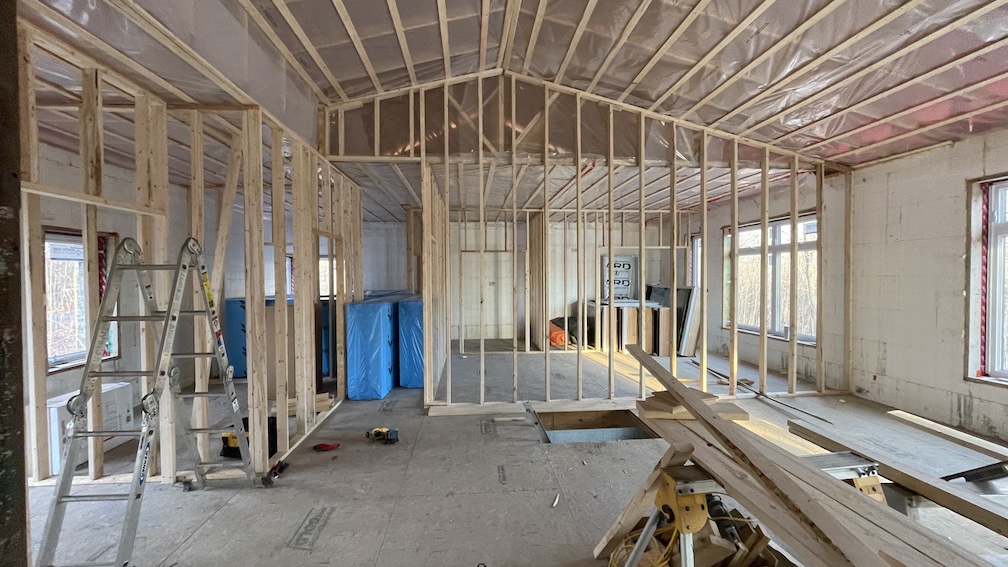
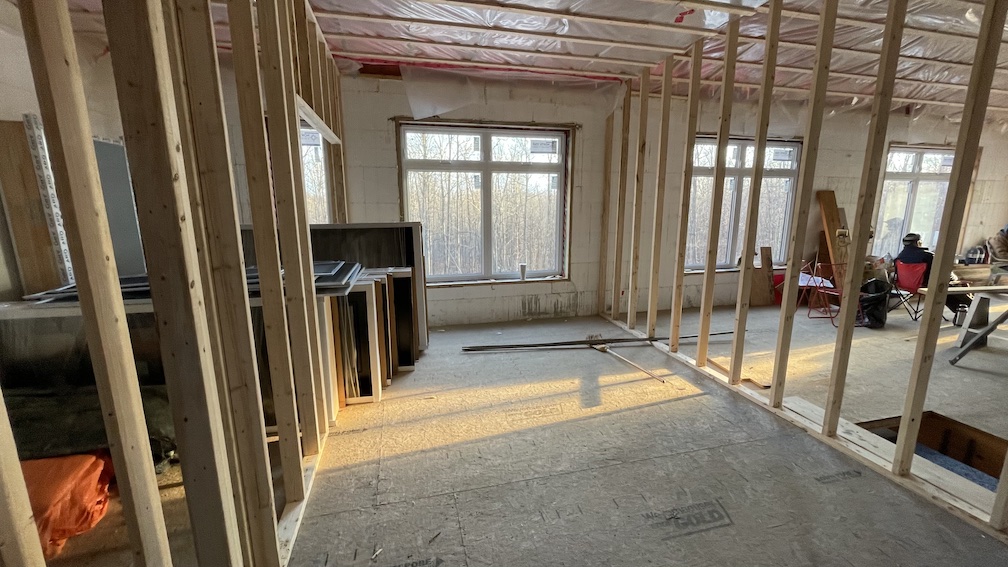


In floor radiant heat is a production. Layers, a number of layers. First, a deep level of gravel, going all the way back to the footing. This has to be followed by a vapour barrier. 6 mil thick is the minimum, 10 mil is recommended. I had to forage around to find some of the latter, and Patrick Morin in Pincourt has become my go to store for this and a number of other things. Thick, stiff and rather unwieldy, I struggled to lay it out as evenly as possible over the entire 1350 sq. ft. This also involved making cuts in the plastic in order to place the it over the recently installed plumbing pipes and sump well. This oversized clumsy membrane placement was incidental compared to the next step.
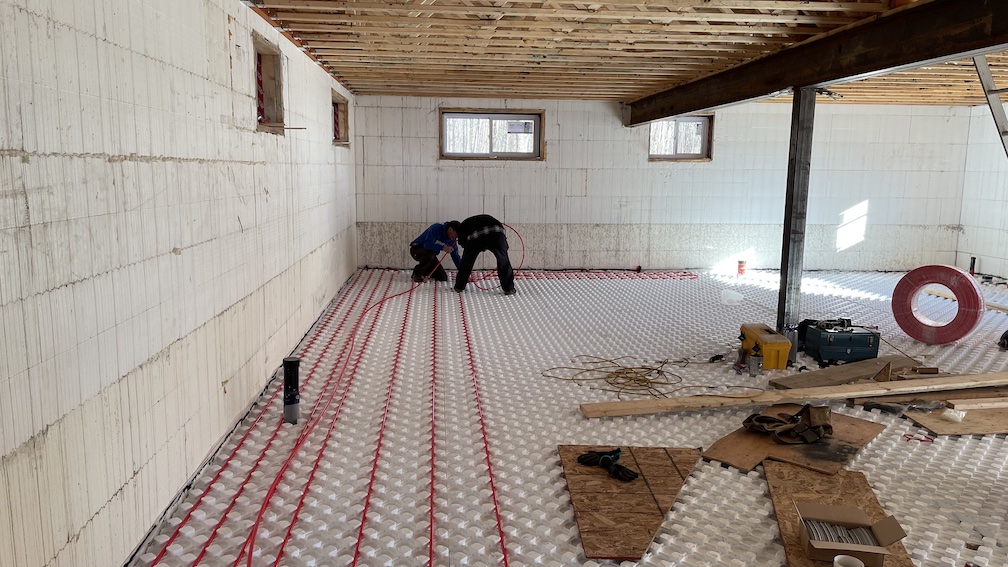
The vapour barrier is there to protect the two and half inches of foam. The foam comes in 8 x 4 foot panels with indentations on top to form channels for the pex piping carrying water or glycol. Shiplap edges form the joints. The panels are laid out in staggered rows over gravel that is far from perfectly even. As you stagger, the panels have to be cut in such a way where the indentations [“pucks”] are properly lined up. Of course, you have to cut out for the plumping pipes, sump well, and pillars in the centre of the basement. There was also a need to cut out pieces of some panels that had been damaged somewhere in the shipping process. When I reached the final corner, fitting what were essentially scrap pieces over 3 pipes while trying to keep the pucks Iined up, I was fit to be tied. Adding insult to injury, walking over the panels was a test of balance, given the pucks don’t make for an even surface, and the less than level gravel meant that panels swivelled and shifted. I was very anxious to get to the installation of the pex pipe and get the floor covered in concrete, which was not obvious from where I was standing.
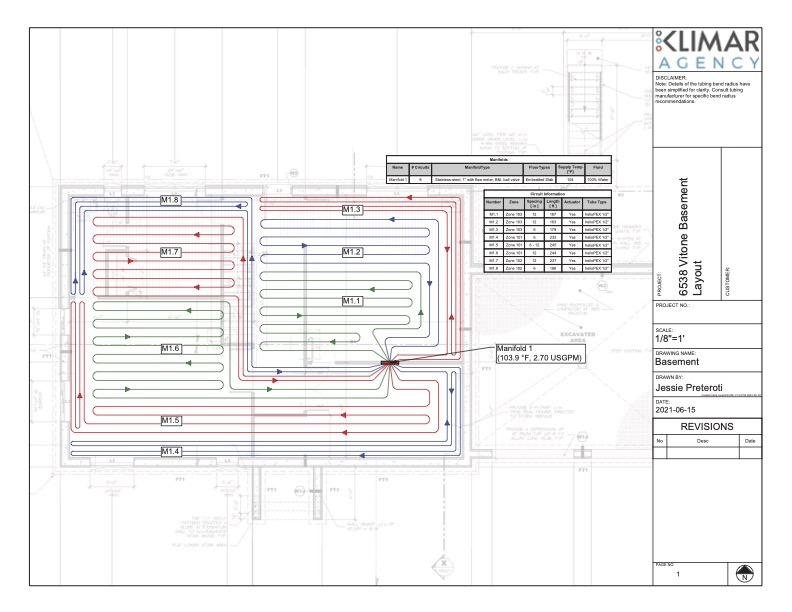
At first, the drawing looks daunting. The pipes on the perimeter are 6 inches apart. The others 12. Mercifully, the pucks are distributed in such a way to make the distancing automatic. On the other hand, this plastic piping is also unwieldy. Cold makes it even more stiff. Dennis borrowed a heater, and I purchased one which will later go in the garage. Both are 240 volts, and Dennis had to add breakers to the panel to plug them in. They kept the space remarkably warm. Richard was around to assist, and using a carrousel device that Dennis and I designed, and he built, they laid down the pipe in one day. I was in and out, because I had to go to Cornwall and get 2 garage door openers for Robbie’s garage door guy who was coming in after the weekend to do the installation. By the end of the day, the piping was all in. From that point, we needed a pressure test and an inspection.



The pressure test is to see if there are any leaks in the pex pipe carrying the heated fluid that warms the concrete and the house. The pressure with the fluid is 12 psi, but the air pressure pumped into the pipes for the test is around 60 psi. I bought a test kit along with the pipe in St-Jerome. It turned out that the fittings that came with the kit leaked, and we were in no position to pass the inspection. Mercifully, Tyler, the building inspector, told us we could change the fittings, do the test, and send him a photo. This we did the following day. He accepted, we passed the inspection, and we were ready to pour, though far from a sure thing. This was December 14 and the cement plant was going to close December 16. Dispatched a text to Robbie hoping he could get Popcorn to squeeze us in. Robbie said he’d work on it.
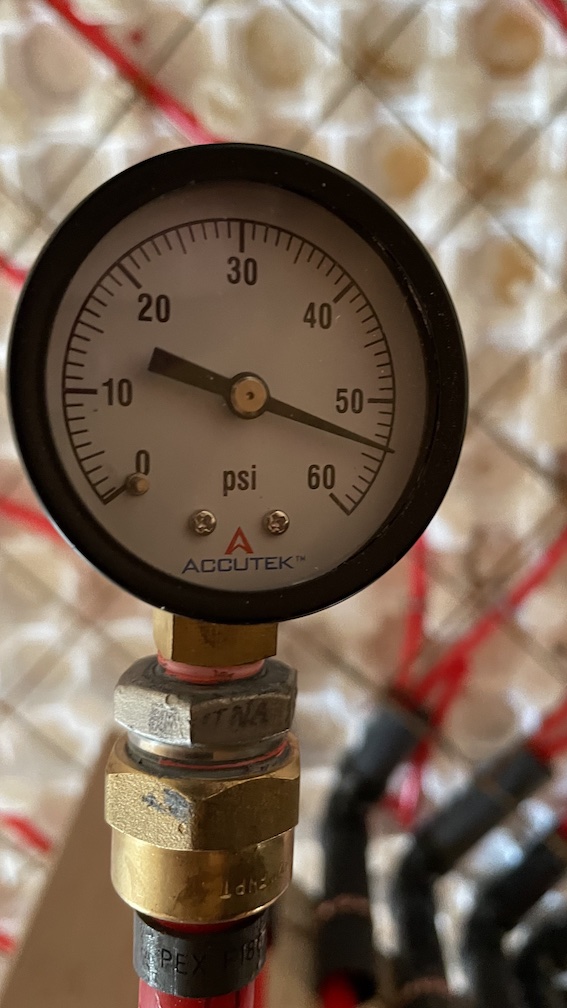

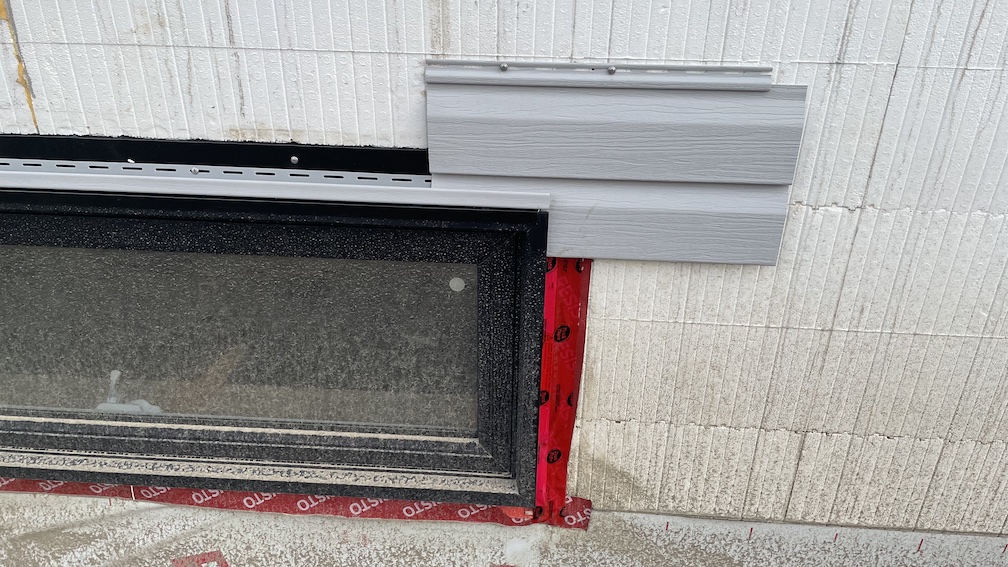
We had a second inspection on the same day, December 13th, to check the air barrier. This refers to all the openings, windows and doors where air and cold could penetrate. On the same day we laid the pipe, December 9th, James and Joe were working on to get ready for the inspection and the installation of the garage doors. James went around spray foaming all the gaps between the windows and doors and their respective frames. On one of the windows, Joe made a prototype of the flashing code requires. He also worked on preparing and capping the bucks for the the garage doors. The installer was scheduled to show up on Monday the 12th, along with Bubba, the plumber’s assistant, who did the rough plumbing on the main floor. In the second to last week before Christmas, there was a rush of activity we hadn’t seen since September.
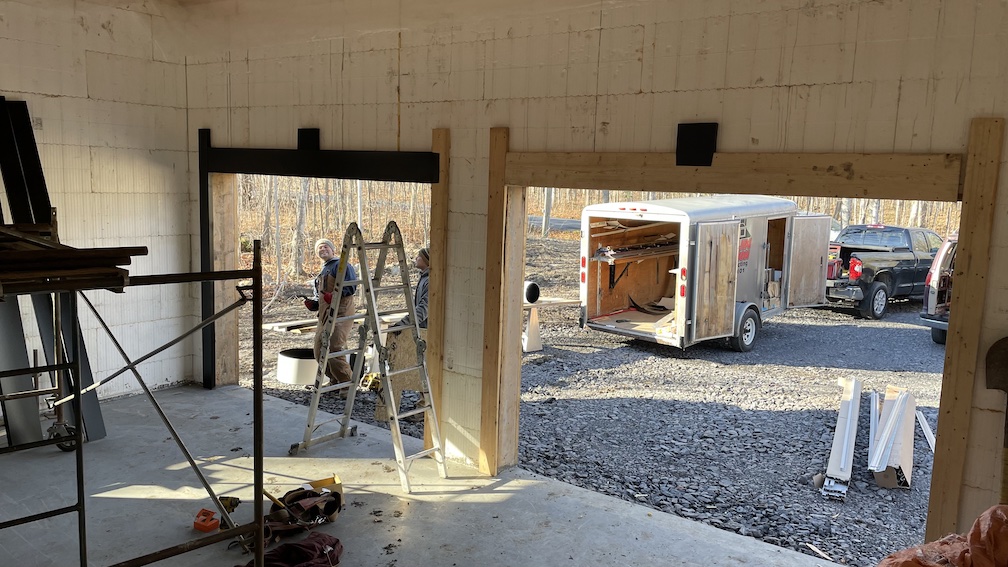

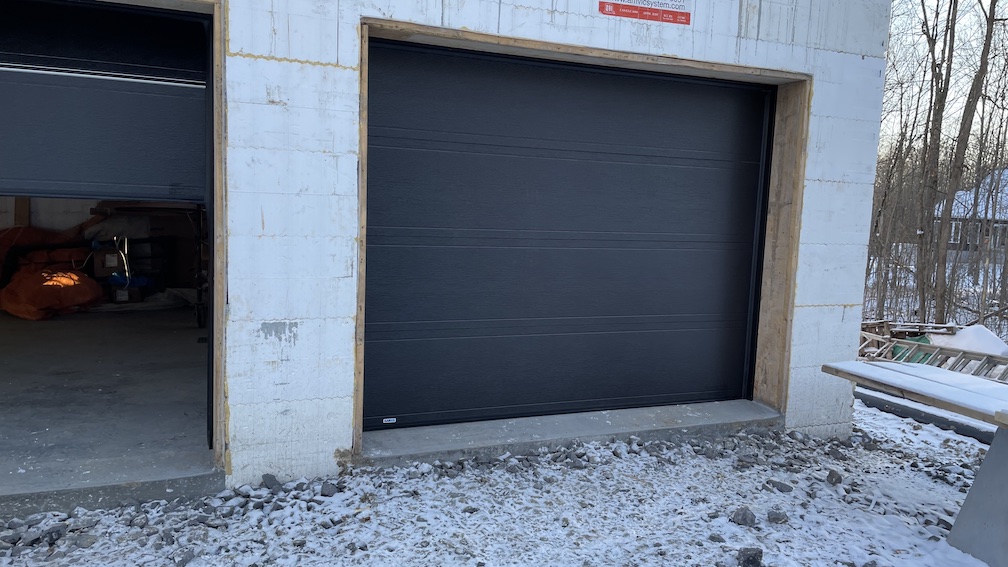


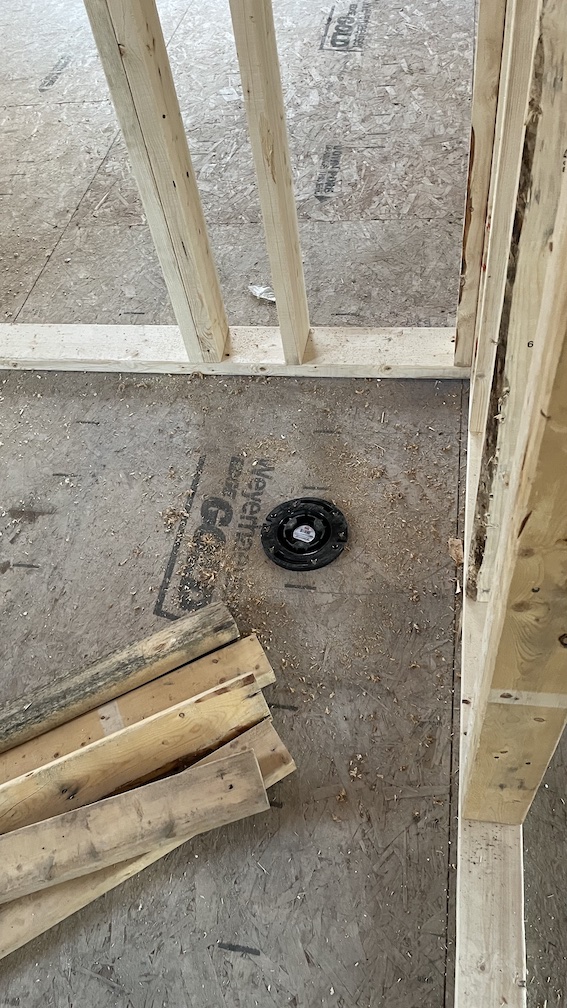

There was no problem passing the air barrier inspection, the boys, and later, Nikki, had done their work. The garage doors are just great, helping to give the house a more finished look. Yet, to be truly finished, the basement floor needed to be poured so that we could install the back door. Could we really get the floor done?
After I had asked Robbie to try to set up a pour, he texted back to ask for specs — size of floor and depth of concrete. I asked if Popcorn wanted us to chalk the line of floor height. Robbie replied saying it wouldn’t be Popcorn, but somebody that Derrick, his cement pump guy, knows.
On Wednesday, the 14th, Dennis and I scrambled to clear everything out of the basement. We hung up the heaters so they would be off the floor and provide heat for the cement curing process. Now we had to wait and see if these guys would show up on the day before the local cement plant closed.
On Thursday morning, the 15th, I get up to have breakfast. I am going to meet with Dennis and the electrician to discuss light placement and other parts of the electrical installation. It’s 8:00 am and I haven’t heard anything from Robbie. Kind of think that, well, we missed that train. By 8:30, bingo!, Robbie texts and we’re on. We got lucky. This crew had a date, but it got cancelled. We tumbled into that breach and made it to the finish line. Not only that, but Joe and James were coming to start the siding. Another busy day.


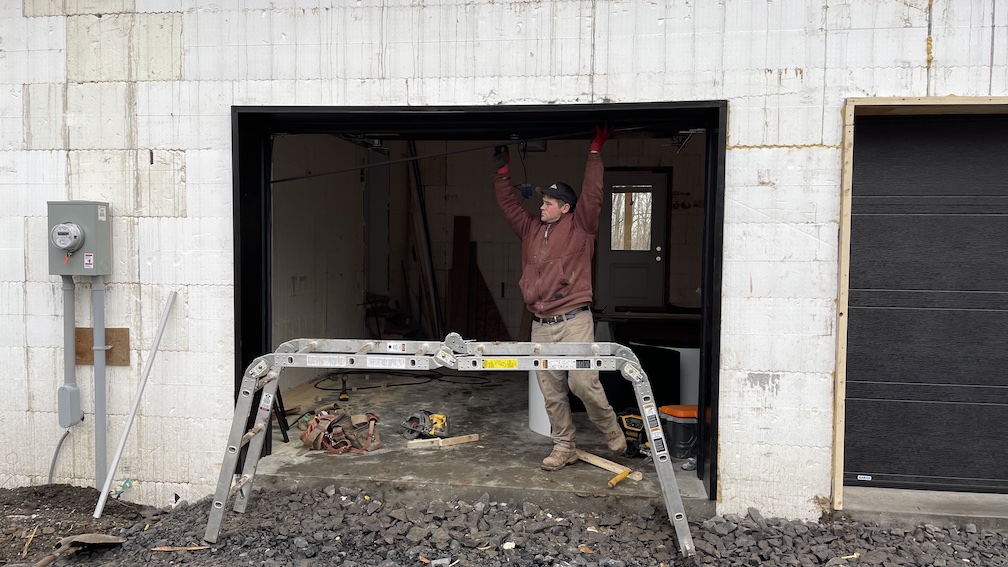


We are looking at the last week before Christmas. Come Friday, Robbie’s crew will break till after the new year. Dennis and I will be doing the same. Again, the weather is working in our favour. Big snowstorm on Friday and Saturday, but most of the week looks fine and mild. Will the boys show up to do more siding? We’ll see. Dennis and I have some insulation to do, put up the basement door, and I would like to throw locks into all the doors. Should work. We’ll see how it goes. Meanwhile, we thank the early winter weather gods.