Solar, or “check with your truss company”
The question of roof solar power loomed from the beginning of the project. Pretty much a commonplace these days, and a number of people asked if we had plans for it. From the little I knew about it, I expected that it would be pricy enough, and there was likely neither the budget, nor a return on investment to make much difference in my lifetime. It turns out, it’s more complicated.
When the house project started, a web search led me to the Energy Hub site and it confirmed the sizable cost, though less than I expected, running at $22-25K for a 8.5 kW system. The site also pointed out that even with Ontario averaging 1166 hours of sun per year, 40 hours above the national average, the province has no renewable energy incentives, and has the third worst clean energy policies in the country. I also knew that the price Hydro One was buying the power generated had dropped from what it had been a few years back. Not a lot of incentive.


Since 2020, the feds were offering incentives on a number of energy efficiency measures, including solar, but inexplicably, these were all directed at retrofits with absolutely nothing for new builds. Having tried and failed to persuade so many HVAC companies to offer anything but propane based systems for radiant heating, it seemed to me that if ever there was a target for these incentives it is new builds. As a result, many new homes are will be outfitted with fossil fuel heating for decades to come. How stupid.
Upon closer examination of the program, a newly built house becomes eligible for retrofit grants 6 months after completion. Well, better, but still stupid, given that the approval is based on recommendations of an energy efficiency report done on the home. What are you going to do? Put in bad windows, do the report, and change over to subsidized efficient windows? Outrageous.
It did appear, though, that an energy efficiency report would recommend solar if absent. Okay, wait six months, do the report and apply. You become eligible for a $5K grant on the solar system, with an extra $1K if it includes a battery. An interest free loan for up to $40K that can be paid back over ten years is possibly the best part of the program.
During the septic review, I spoke with the inspector, Mike Madden, who has an interest in most things environmental. He suggested I speak with the folks at Solar Tech Canada in Hawkesbury to get info on a system and a quote. I did this. Spoke with Steve and he gave me an estimate for a 10 kW system that includes panels, an inverter and two 4.5 kW batteries. Cost with roof racking, installation and taxes, about $30K. About $10K less without the batteries that are to be used for emergency power. $24K after subtracting $6K in grants which could be financed with the interest free loan. Furthermore, feeding back to the grid would provide $2-3K in credits over the year which just about covers the cost of the loan. Attractive? Indeed. But, of course, it can’t just end there.
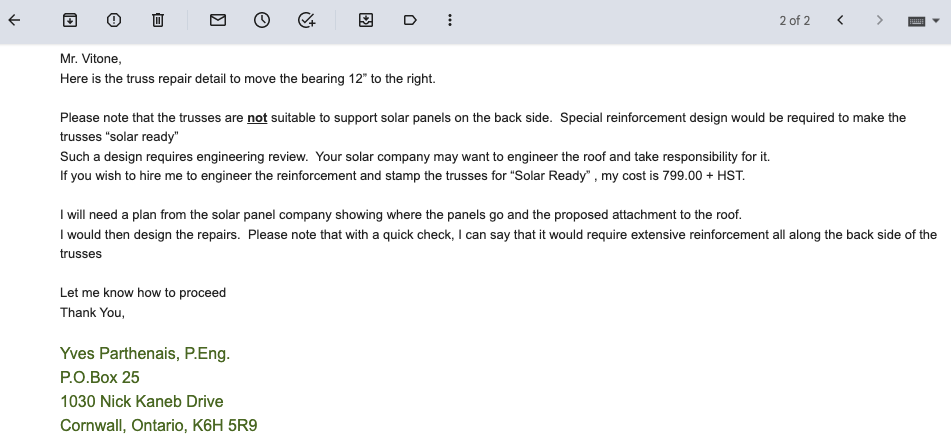
The phrase “you might want to check with your truss company” has come to make me wince. The building inspector has said this to me 3 times so far. Two of the times it has been mentioned so far has required modifications to the trusses. The first had to do with moving the garage up a foot to meet the house front wall. The second is noted above, and as is clear in the email, is expensive. The third has to do with replacing a wall footing with a pillar on the back porch. Yet, to hear about the latter — I’m still wincing.
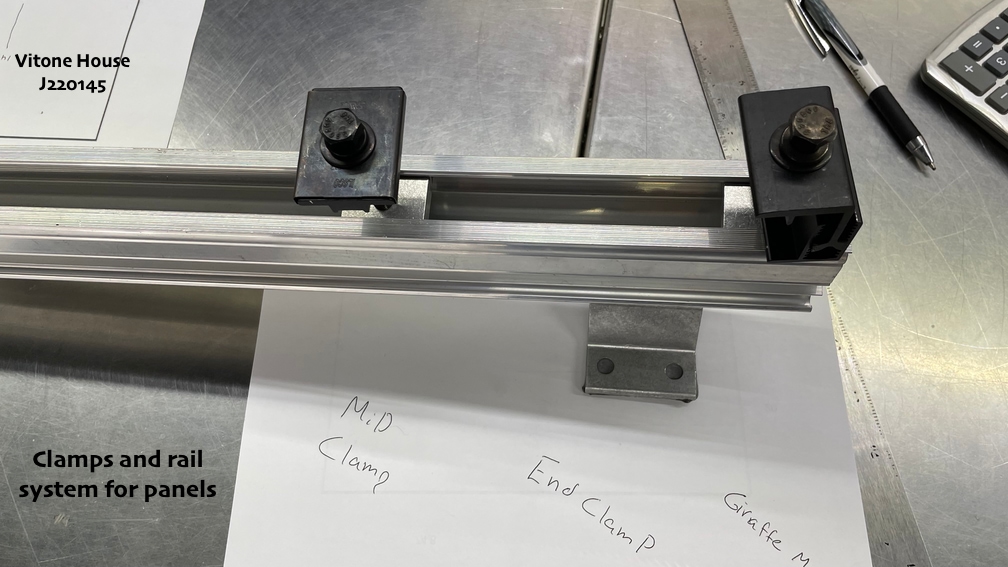
770 pounds dead weight over 532 square feet, plus the average snow load puts high stress on the trusses. Part of the solution involves adding a 16 ft. 2 x 4 to the upper edge of the trusses in the area on the roof where the panels will sit. More crucially, there are difficulties involved with the attachment to the roof. The dealer’s setup had the rack holding the panels tied to the roof with 40 fasteners. To distribute the weight safely, the engineer evaluated the pressure points had to be doubled. This meant going from 40 fasteners to 80. All good? No.
Dennis is a cautious, conservative builder. We’re putting on a steel roof. Steel roofs are flat with raised spines at regular intervals. They are attached to wood strapping with screws placed on the spines of the steel sheets. This method involves the seeming contradiction of making a hole in your roof to attach it. You want to do this on the raised spine as negligible amounts of water will hit the area, and it will fall and flow immediately onto the flat.
The proposal from the engineer requires 80 fasteners. Not only do these fasteners require 4 holes each, they are to be screwed onto the flat of the roof. That’s you, voluntarily making 320 holes on the flat of your roof. Now Dennis is wincing. A call to the manufacturer has him assuring me that a gasket and sealer does the job of making the holes waterproof. Dennis says, sure, now, but what about 10 years from now? If I am still around, I’ll be 80, a likely phone scam victim. Do I want to have to fix a leaking roof? Dennis says check with the dealer to see what is the real world experience. I go visit. Some consternation from the owner and Steve his son. It turns out these fasteners have been around for about 8 years. No issues, but 8 years. Mike, the owner, not trying to string me a line, assures me they’ll make the 2 extra years, no problem. I am wincing, and I still have yet to bring this news back to Dennis.
Little said so far about the actual solar setup, what it can do, and it’s actual worth. Yet, these are the rabbit holes that one can be driven into when all you are trying to achieve is some energy efficiency for yourself and the wider world. What to do? Well, $900 later, we have an engineered certified plan to give the township that will make it possible for them to grant permit. We’ve got a good year before the house becomes a retrofit. The application process will take another few months. Who knows? A less worrisome solution may emerge in that time. The hope sidelines the wincing for now.